After over 100 years, the stolen Idol of Annapurna returns to Kashi from Canada, installed at Kashi Vishwanath Mandir in Varanasi.

by Staff Reporter
November 15, 2021
An 18th-century idol of Annapurna, which had embarked on a journey back home to Kashi from Canada, was installed at the newly-constructed Annapurna temple inside the Kashi Vishwanath temple corridor on November 15. Chief Minister Yogi Adityanath attended the pran pratistha (consecration) of the deity.
An 18th-century idol of Maa Annapurna, which was stolen from Varanasi more than 100 years ago and later found in a museum in Canada, was installed at the Kashi Vishwanath Mandir in Varanasi on November 15. The Idol, transported across the state on a lavish chariot in a Shobha Yatra, passed through 18 districts over four days before arriving in Varanasi shortly after midnight on Sunday, November 14.
The Idol was handed over to the Uttar Pradesh Government on Thursday at the national capital at a colourful event amid a cheering crowd of devotees. Union Minister for Culture and Tourism G Kishan Reddy presented the Idol to Suresh Rana, the Yogi Adityanath government minister. Minister of Women and Child Development Smriti Irani and Minister of State for External Affairs Meenakshi Lekhi in the Union Cabinet were also present.
After the handing over ceremony, the grand procession (shobhayatra) carrying the Idol of Goddess Annapurna started, with brief stopovers at Mohan Mandir in Ghaziabad and at Dadrinagar Shiv Mandir in Gautam Buddha Nagar. After that, it proceeded to Bulandshahar, Aligarh, Hathras, and Kasganj. On Friday (November 12), the shobhayatra had stopovers in Eta, Mainpuri, Kannauj, and Kanpur. On Saturday (November 13), the shobhaytra traveled to Unnao, Lucknow, Barabanki, and Ayodhya, where it had an overnight stay.
It finally reached Varanasi on November 14 via Sultanpur, Pratapgarh, and Jaunpur.
The Idol was installed at the Kashi Vishwanath temple amid chanting of Vedic hymns at a formal ceremony on the occasion of Devotthan Ekadashi. The Idol was consecrated by Uttar Pradesh chief minister Yogi Adityanath in the Kashi Vishwanath Mandir.
The return of the Annapurna idol from Canada to India was announced by Prime Minister Modi in his weekly Mann Ki Baat radio address last year on November 29. PM Modi had informed that Canada will be returning a very ancient idol of Devi Annapurna, stolen from a temple of Varanasi and smuggled out of the country about 100 years ago.
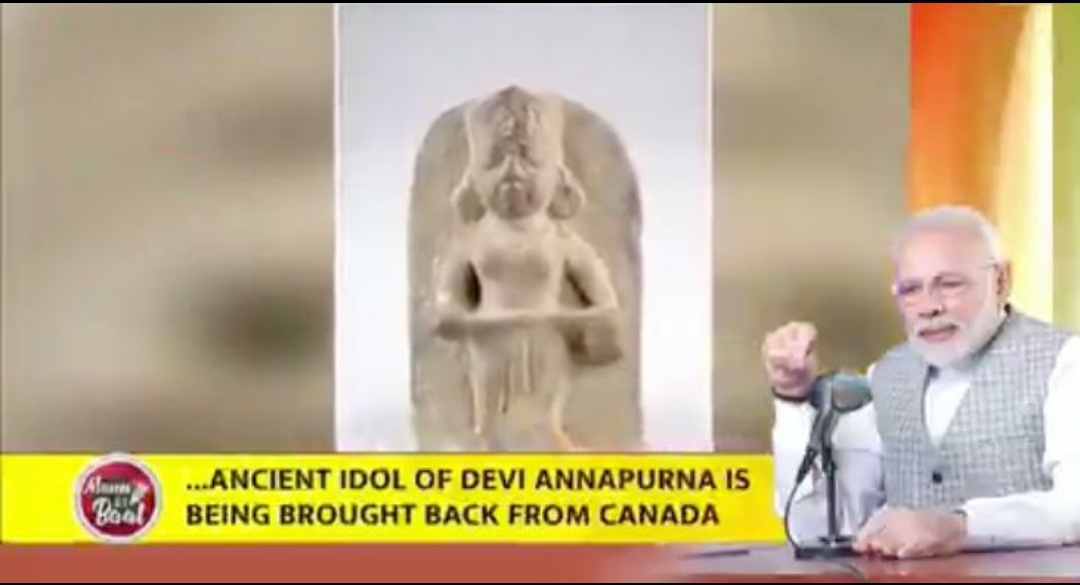
"Mata Annapurna has a very special bond with Kashi [Varanasi]. And the return of the Idol is very pleasant for all of us. Like the statue of Mata Annapurna, much of our heritage has been a victim of international gangs," the PM had said.
Annapurna, also spelled Annapoorna, is the Goddess of food and also the deity of the city of Varanasi. The Idol found in Canada is 17 cm in height, 9 cm in breadth, and 4 cm in thickness.
The Idol was discovered by Artist Divya Mehra, an Indo-Canadian, at the University of Regina's collection at the MacKenzie Art Gallery in Regina, Saskatchewan, Canada. Mehra had been invited to stage an exhibition at the gallery when she started researching the collection at the university and spotted the Idol, which was misidentified to be Lord Vishnu. She noticed that the sculpture appeared to be female, and it was holding a bowl of rice.
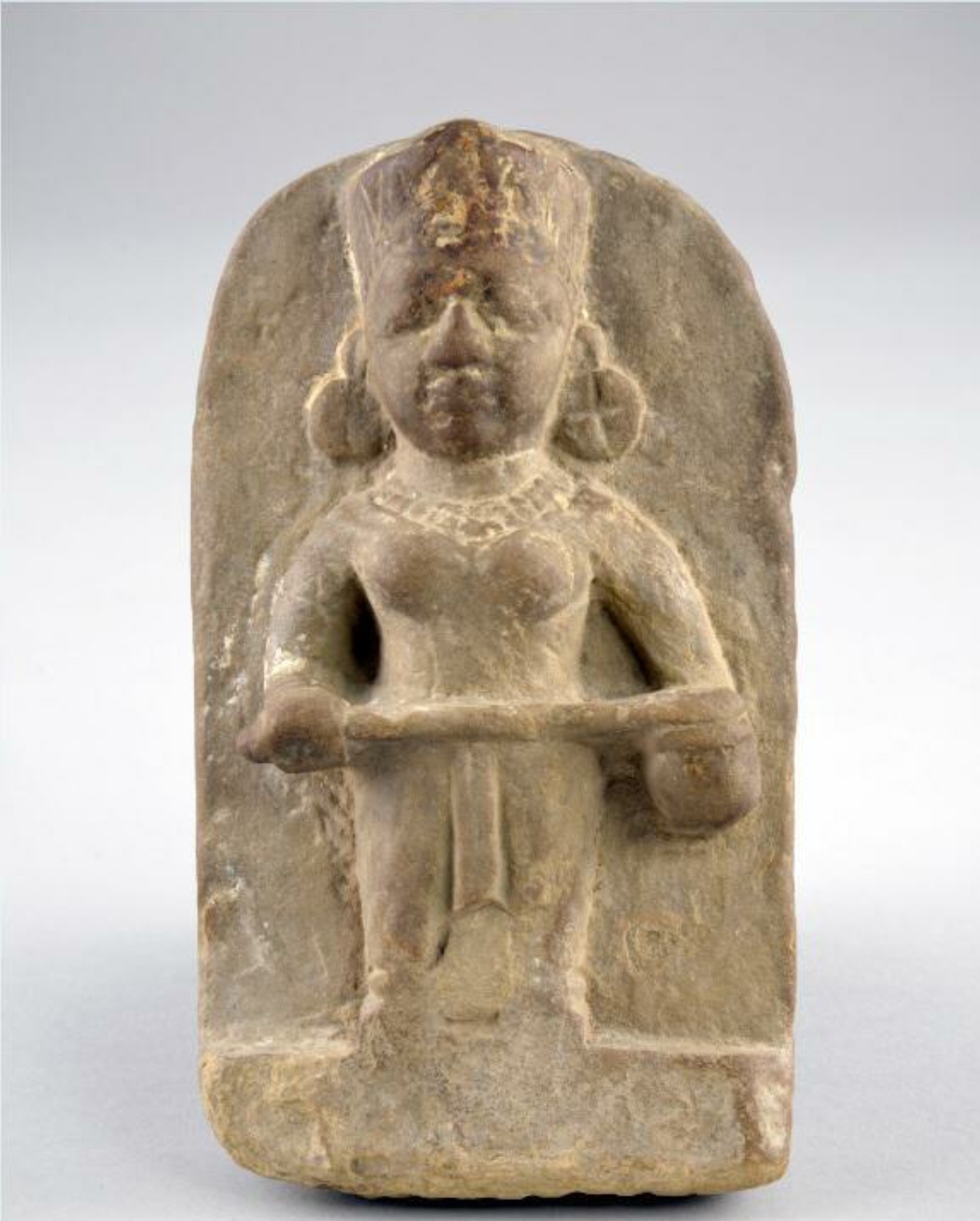
Searching the records, she found that the Idol was stolen from an active temple in India in 1913, and it was acquired by MacKenzie. Siddhartha V Shah, Curator of Indian and South Asian Art at Peabody Essex Museum, US, later confirmed that the sculpture is indeed of Goddess Annapurna. She has a bowl of kheer in one hand and a spoon in the other hand, items associated with the Goddess of food.
Divya Mehra's research showed that the Idol was given to Canadian art patron Norman MacKenzie by a stranger after stealing it from a temple in Varanasi. It was part of the private collections of MacKenzie, which he had donated to Regina College (later university), and the Norman MacKenzie Art Gallery was established by the college to showcase this collection.
After confirming the identity of the Idol, Mehra talked to the CEO of the Gallery and requested its repatriation. After learning about the discovery of the stolen statue, the Indian High Commission in Ottawa moved quickly to secure the repatriation of the Idol and alerted authorities in India. The Department of Canadian Heritage also came forward and offered to assist with the repatriation.
While handing over the sculpture to India at a virtual ceremony held last year, University of Regina's Vice-Chancellor Thomas Chase had said, "As a university, we have a responsibility to right historical wrongs and help overcome the damaging legacy of colonialism wherever possible." He had further added, "Repatriating this statue does not atone for the wrong that was done a century ago, but it is an appropriate and important act today."
Accepting the return of this cultural icon, High Commissioner of India to Canada, Ajay Bisaria, had said, "we are delighted that this unique Annapoorna Devi is on her way home." While expressing gratitude to the University of Regina for their proactive engagement in returning the statue, the High Commissioner added, "the move to voluntary repatriate such cultural treasures shows the level of maturity and understanding in India-Canada relations."
The Idol was displayed at the University gallery and again at the Indian High Commission in Ottawa as part of the Independence celebrations on August 15, 2021.
This is not the first time that Canada has returned stolen pieces of heritage to India. A press release from the Indian High Commission had said that in 2015, during the visit of Prime Minister Narendra Modi to Canada, the then Canadian Prime Minister Stephen Harper had presented the "Parrot Lady" sculpture, a 900-year-old red sandstone statue, to Prime Minister Modi, for return to India.
The Union Minister for Culture and Tourism of India recently said that as many as 42 rare idols and antiquities have been returned to the country by different countries during the tenure of Prime Minister Narendra Modi. In contrast, from 1976 to 2013, only 13 rare works of art could be brought back.